

Prismatic vs Cylindrical vs Pouch Lithium Cells: Engineering Selection & Format Trade-Offs
Detailed technical comparison of prismatic, cylindrical, and pouch lithium battery cells for engineers. Analyze volumetric packaging efficiency, thermal dissipation, mechanical rigidity, and tab joining methods.
Choosing between prismatic, cylindrical, and pouch cell formats is one of the foundational architectural decisions in any battery engineering program. Each form factor represents distinct engineering trade-offs in volumetric packaging efficiency (CTP ratio), mechanical integrity, thermal heat dissipation geometry, and tab joining methods. A design that excels in an energy storage container can prove impractical in an aerial drone or robotic limb. This guide provides an unbiased, parameter-by-parameter analysis to help engineering teams select the optimal format for their duty cycle.
Select prismatic cells (50Ah–314Ah+) for stationary ESS and heavy industrial vehicles prioritizing high volumetric energy density (CTP > 70%), integrated laser-welded busbars, and robust aluminum rigidity. Choose cylindrical cells (18650, 21700, 32700) for high-vibration mobile platforms, power tools, and modular designs where individual cell fusing and radial thermal isolation minimize propagation risks. Choose pouch/polymer cells for weight-critical UAVs, thin smart devices, and high-rate burst discharges (25C–60C) where flexible envelopes and superior surface-to-volume thermal cooling outweigh swelling containment overhead.
External Standards & References

Top architecture of a Grade-A prismatic LFP cell with integrated safety vent and copper-aluminum composite terminals.
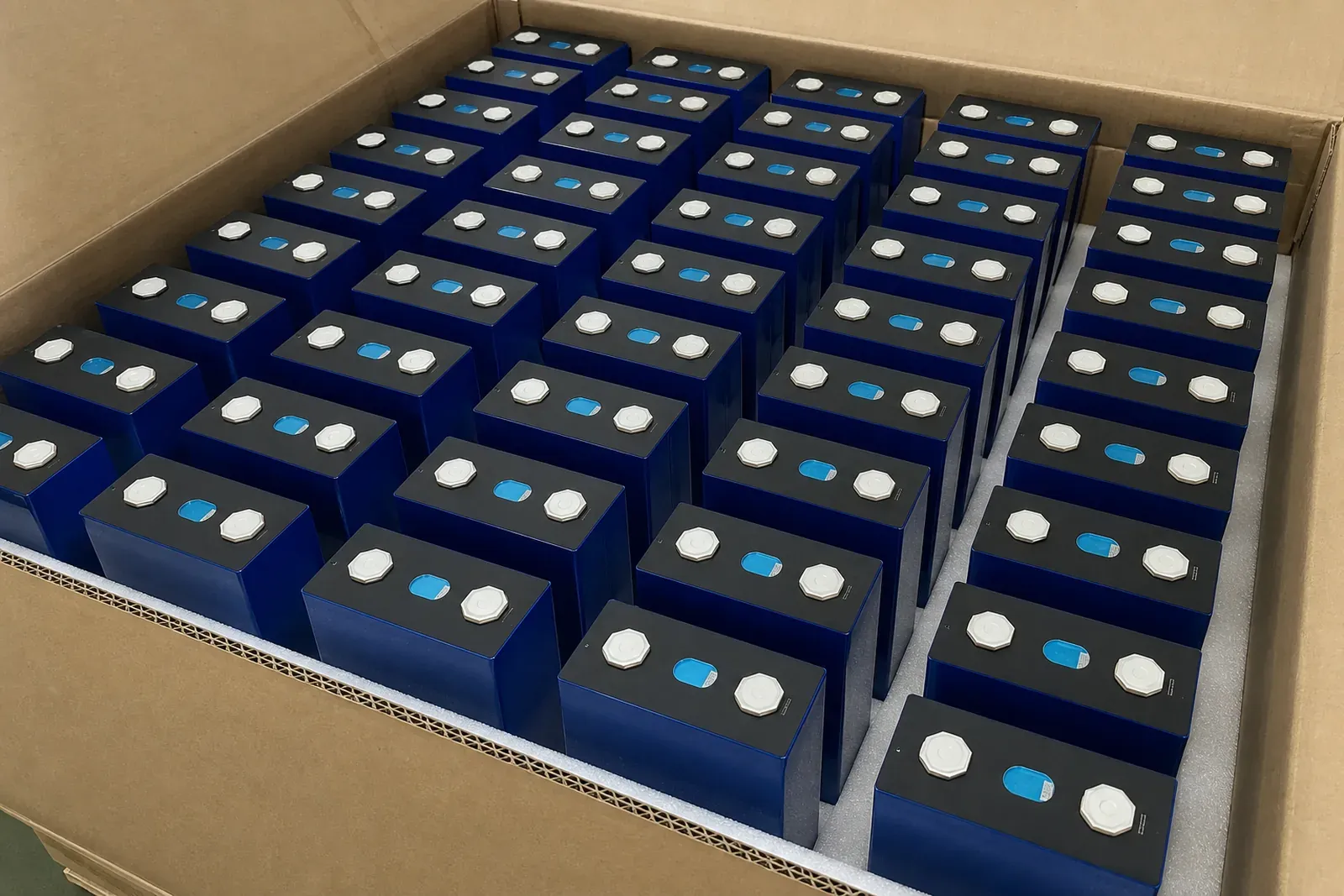
Prismatic cells packaged in custom honeycomb dividers to isolate aluminum casings from transit abrasion.
1. Volumetric Density & CTP (Cell-to-Pack) Structural Efficiency
Volumetric packaging efficiency determines how much usable kilowatt-hour energy fits within a confined cabinet or chassis bay. Prismatic cells feature rectangular geometric cross-sections that stack flush against one another, eliminating wasted void space. In modern CTP (Cell-to-Pack) systems, prismatic platforms achieve volumetric utilization rates exceeding 70% to 75%. Cylindrical cells, by contrast, leave 10% to 15% inherent interstitial space between cylinders even in tight hexagonal close packing, while pouch cells require perimeter margin allocations for seal edges and swelling compression plates.
-
Prismatic format: 70–75%+ volumetric CTP packing efficiency
-
Cylindrical format: 55–65% CTP efficiency due to interstitial voids
-
Pouch format: Highest gravimetric density (Wh/kg), but requires external cage volume
-
Prismatic layout requires fewer overall cell interconnections than cylindrical arrays
2. Thermal Heat Dissipation Paths & Cooling Geometry
Heat generation under load follows Joule dissipation and electrochemical entropy change. Cylindrical cells conduct heat primarily in the radial direction toward the curved steel can, making interstitial airflow or serpentine liquid cooling channels natural choices. Prismatic cells present broad, flat aluminum faces ideally suited for high-efficiency bottom cold plates or side thermal interface pads. Pouch cells boast the highest surface-area-to-volume ratio, facilitating rapid heat exchange, but require careful tab cooling because high discharge currents concentrate thermal rise directly at the thin foil weld joints.
-
Prismatic: Excellent thermal coupling with bottom liquid cooling cold plates
-
Cylindrical: Interstitial channels allow air cooling or serpentine liquid ribbons
-
Pouch: Superior passive dissipation from large face; requires tab heat sink design
-
Prismatic internal temperature gradients require thermal interface gap pads
3. Terminal Busbars & Automation Joining Methods
Interconnecting hundreds of cells demands high mechanical reliability and minimal electrical resistance. Prismatic cells are equipped with substantial copper-aluminum composite terminal posts supporting controlled laser welding or threaded M4/M6/M8 studs for bolt-on busbars. Cylindrical cells require automated resistance micro-spot welding or high-speed fiber laser welding with nickel-plated copper strips. Pouch cells require ultrasonic metal welding of fragile aluminum and copper foil tabs, which must be mechanically supported against vibration fatigue.
-
Prismatic: Robust laser-welded busbars carrying hundreds of continuous amperes
-
Cylindrical: High-speed spot or laser welding with cell-level fusible links
-
Pouch: Ultrasonic foil welding requiring potting or clamped terminal blocks
-
Laser-welded studs on prismatic cells eliminate customer on-site welding risks
4. Mechanical Integrity, Abuse Behavior & Swelling Management
Electrode materials expand and contract during lithiation and delithiation cycles. In prismatic cells, internal jelly-roll expansion exerts lateral pressure on the aluminum can; packs must incorporate structural compression plates and spring-loaded end brackets to maintain optimal internal pressure (typically 0.1 to 0.3 MPa) over their lifespan. Cylindrical steel cans possess inherent circular hoop strength, resisting internal gas pressures up to 3 MPa before their Current Interrupt Device (CID) disconnects. Pouch cells experience unconstrained thickness swelling (up to 8% to 12% at end of life) and require rigid external compression clamping.
-
Prismatic packs require calculated end-plate pre-tension to manage swelling
-
Cylindrical cells feature integrated mechanical CID and PTC overcurrent devices
-
Pouch cells require 10% thickness envelope margin to accommodate aging expansion
-
Aluminum prismatic cans provide superior side puncture and impact protection
5. Engineering Decision Matrix by Duty Cycle and Platform
When selecting a form factor, match the primary project constraint—energy density, footprint, vibration profile, or discharge rate—to the inherent format strength. The table below represents empirical engineering fitment across industrial programs.
-
Stationary C&I / Residential ESS: Prismatic LiFePO4 (280Ah/314Ah) for lowest levelized cost and maximum volumetric density
-
AMR, Robotics, & Industrial Power: Cylindrical 21700 / 32700 for vibration tolerance and modular bay layouts
-
High-Rate UAVs & FPV Drones: Pouch LiPo cells for 25C–60C discharge rates and minimum tare weight
-
Portable Power & Compact Devices: 18650 cylindrical or shaped small pouch for tight dimensional integration
Engineering Baseline
Form-Factor Engineering Selection Checklist
Technical inputs recommended for engineering validation before final system architecture and quoting:
Mechanical bay dimensions: length, width, height & swelling margin
Target system gravimetric energy density (Wh/kg) vs volumetric density (Wh/L)
Continuous and peak discharge C-rate requirements
Cooling system architecture: ambient air, forced airflow, or liquid cold plate
Vibration and mechanical shock standards (e.g., ISO 16750, UN38.3)
Busbar connection preference: laser-welded busbars vs threaded studs
Internal cell fusing requirements for parallel failure isolation
Production volume: prototype tooling vs automated high-volume line
Target duty-cycle operating lifespan and allowable capacity fade
Target safety and transport certifications (UN38.3, IEC 62619, UL 1973)
Related products and applications
Continue to the relevant product and engineering pages.
Grade-A Cell Sourcing & Precision Matching
Screened cells across prismatic, cylindrical, and pouch formats with verified batch reports.
Open Grade-A Cell Sourcing & Precision Matching →Cylindrical Lithium Cells Overview
Explore 18650, 21700, and 32700 standard cell capacity and discharge bands.
Open Cylindrical Lithium Cells Overview →Pouch and Polymer Lithium Cells
High-rate LiPo and high energy density pouch platforms for OEM pack integration.
Open Pouch and Polymer Lithium Cells →FAQ
Prismatic vs Cylindrical vs Pouch Lithium Cells: Format Selection Guide | Staricell
Why do prismatic cells dominate stationary energy storage?
Stationary ESS prioritizes levelized cost of storage (LCOS), long calendar life, and high volumetric efficiency over lightweight construction. High-capacity prismatic cells (such as 280Ah and 314Ah) drastically reduce the total number of series-parallel electrical connections, BMS sensing channels, and structural components compared to cylindrical clusters.
What happens if prismatic cells are assembled without compression fixtures?
Unconstrained prismatic cells experience internal electrode delamination as active materials expand during cycling. This causes impedance rise, localized gas pockets, premature capacity drop, and accelerated swelling that can deform the battery enclosure. Applying 0.1 to 0.3 MPa calibrated compression extends cycle life by 20% or more.
Can cylindrical cells match the energy density of pouch cells?
At the bare-cell level, pouch cells typically achieve 10% to 15% higher gravimetric energy density (Wh/kg) because their laminated aluminum film is far lighter than steel cans. However, at the complete pack level, the gap narrows significantly because pouch packs require heavy external compression plates, cooling plates, and rigid enclosures to manage expansion.
Why are pouch cells preferred for racing and UAV applications?
Racing drones and heavy-payload UAVs require continuous discharge rates of 25C to 60C and rapid 5-minute mission profiles. Pouch LiPo cells feature multi-tab stacked foil internal architectures, delivering negligible internal impedance and massive surface heat dissipation that cylindrical cells cannot duplicate without severe thermal throttling.